A Debate That Will Never Be Settled: College Athletes to be Paid or Not?

Imagine trying to negotiate a contract with an 18-year-old about the next four years of his or her life.  That is what would happen if it was decided that college athletes should, in fact, be paid for participating in a sport while attending college.  This is a debate that has been going on for decades now and will most likely never have the resolution that will satisfy everyone.  Some people believe that college athletes, without a doubt, should be paid.  On the other hand, others believe there is no reason for college athletes to get paid and that it would an extremely difficult change to adjust to, and one that would likely be even more difficult to regulate and manage.  Although there are pros and cons on both side of this argument, I believe there are better reasons for college athletes not to get paid. 

Those who support the idea of paying college athletes usually site the fact that colleges make a lot of money from the sports these athletes play.  They say that the athletes should financially benefit because of this fact.  They also argue that the athletes are asked to devote an incredible amount of their time to their sport, should be compensated.  On the surface, these are logical statements, but the issue goes much deeper and is much more complicated than just paying some money to athletes.

If college athletes were to be paid, what athletes from which sports would be paid?  For most schools, men’s basketball and football bring in the most revenue for their schools.  Since that is the case, it would make the most sense to pay the players on those two teams.  But, what about the women’s crew team, the men’s baseball team, or the bowling team?  The athletes on those teams put in just as many hours practicing, lifting, training and going to meets and games as the football and basketball teams, so should they not also get paid? Determining something like this would be extremely complicated.

Adding to that, many people question if women and men in collegiate sports should get paid the same amount.  In many jobs today, a man is still paid more for doing the same job as a woman.  This has improved significantly over the years, but it is still the case in many industries.  Title IX states that “No person in the United States shall, on the basis of sex, be excluded from participation in, be denied the benefits of, or be subjected to discrimination under any education program or activity receiving Federal financial assistance.”  In addition, according to the NCAA Gender Equity Task Force, “An athletics program can be considered gender equitable when the participants in both the men’s and women’s sports programs would accept as fair and equitable the overall program of the other gender. No individual should be discriminated against on the basis of gender, institutionally or nationally, in intercollegiate athletics.”  That being the case, it can be determined that male and female athletes have to be treated exactly the same.  Would this apply to all athletic programs or just the most popular and profitable programs?

Another problem with college athletes being paid is figuring out how much the athletes should be paid.  The top football schools in the nation are the Ohio State University, University of Georgia and University of Alabama.  At OSU’s home stadium, there are 104,944 seats and every home game of the season sells out according to America’s Best Football Colleges of 2018 article.  Also, in 2017, the team ranked as the priciest in NCAA, being valued at $1.5 million.  For Georgia, during the 2017 season, there was a total of 556,476 fans at their six home games which totaled more than 1.2 million fans at both home and away games that season.  Lastly, the University of Alabama has made 65 bowl appearances, has 30 conference titles, 17 nation titles, and 69- All-American award recipients.  Clearly, all three schools have the best players in the nation.  So, does that mean they should get paid more than athletes on a team like Duquesne, which is also a D1 football program, but at a much smaller level?

Further, even if it was decided that only the athletes on the football and men’s basketball teams would be paid, would all team members be paid the same?  It doesn’t make logical sense to pay the twelfth player on the basketball team the same as the star player.  Or, would this be part of the negotiating process during the recruitment process?

Let’s not forget that there are also Division II and Division III schools as well.  Even though Division I sports are the most popular in the United States, Division II and III athletes work just as hard Division I athletes.  Again, it would be very complicated to determine where to draw the line.

There are just too many questions with too many very difficult answers.  The NCAA already has its hands full trying to oversee the athletic programs as they are currently set up.  Adding a serious financial component to their duties will result in endless problems for the NCAA and the colleges.  While there are most certainly some programs who bend, and possibly, break, the current rules, the probability of abuse will be much worse if the athletes were allowed, to be paid.

Also, it is clear that scholarship athletes already receive a form of payment for attending school and playing a sport.  At most schools, student athletes have access to the best gyms on campus, more meal swipes than the average students, and free transportation.  Most importantly, athletes receive an education that can be valued up to $200,000 or more depending on which school they attend. 

When speaking to others about this topic, they had very strong opinions.  A senior at La Salle University, Maeve Hughes works within La Salle’s athletic department as a videographer for the men’s basketball team and agrees that college athletes should not be paid.  “College athletes should not get paid because they receive scholarships which can amount to over $200,000.  Along with tuition, athletes receive benefits like free textbooks along with food allowances.  Most programs already struggle to stay afloat financially and having to pay the athletes would not benefit the program, and in return overall, not benefit the athletes,” says Hughes.

College students are usually not financially responsible.  Whether an athlete or not, few college students know what they’re doing with their money.  There are several cases involving young players in professional sports that have serious money issues once they make it to the professional level.  This happens because they are receiving large amounts of money at ages as young as 19 and think they can spend it all with no consequences.  There are too many examples of this happening to discuss, but it can be inferred that paying them at an even younger age would make the problem worse.

It has been proposed that a flat fee, or allowance, could be paid to all athletes.  But again, what does that mean?  Do all athletes receive this allowance?  Men and women?  Is the allowance the same across all programs at all schools in all divisions?  Even if those questions could be adequately answered, the probability of abuse would still exist, particularly in the money-making programs at the biggest schools.  In that is the case, what would have been accomplished?

Finally, what about the exceptional students who are not athletes?  Many students who may or may not be on academic scholarships are working just as hard as the athletes.  Perhaps they are making great contributions to their institution and their chosen field.  Should they not be rewarded as well?

In a perfect world, college athletes should be attending college in order to get an education, playing a sport they love, and, in some cases, trying their best to make to the professional level.  However, the majority of these student athletes will not move up to the professional level in their chosen sport.  Their focus should be on taking advantage of the free education they are receiving.  At the end of the day, figuring out recruitment contracts, money, and additional logistics would only add complications to what the NCAA and colleges are already having trouble managing.

Work cited:

https://www.bestcolleges.com/features/best-football-colleges/

https://www.tickpick.com/ohio-stadium-seating-chart/

https://www2.ed.gov/about/offices/list/ocr/docs/tix_dis.html

Click to access Athletes_Reasons-NOT-to-pay.pdf

Melissa Moran: Winning On and Off the Field

But once again something went wrong with her initial plan. 

Three credits, that is all Melissa Moran needed to be a D1 lacrosse athlete.  Most people know that three credits is only one class, so it does not sound too bad, but things are not always as easy as they seem.   When Syracuse native, Melissa, transferred to Duquesne in the spring of 2017, she thought all her dreams of becoming a D1 athlete were coming true, until she found out she had to red shirt for the spring season due to being three credits short of her class year. 

Transferring once is already extremely hard, so doing this process twice and not being able to relieve stress in the one way she knew how too was severely challenging.  In the fall of 2016, after two years of playing lacrosse at Monroe Community College in Rochester, New York, Melissa went on to attend the University of Pittsburgh.  There, she planned on studying communications and playing on the Pitt Women’s Club Lacrosse team.  She wanted to continue playing lacrosse but at a less serious level, so she thought. After a few practices, she knew she was better than playing with girls who did not take the game seriously at all.  After only one semester at Pitt, she decided to transfer again, two miles down the road, to Duquesne University to pursue a degree in Sports Information and Media and play lacrosse at a D1 level. 

Her first semester at Duquesne was one the hardest times in her life.  She could not play lacrosse, she was still living over by Pitt after having a bad experience there and she was starting from square one now.  Her mom, Tina Moran, agreed that it was a very hard transition for Melissa.  She said, “Melissa was extremely excited and confident to finally become a D1 athlete.  Her confidence at the time was through the roof.  When she met with her advisor and was told she could not play and would need to red shirt that first season her entire demeanor changed and her confidence level hit rock bottom and you could tell she felt inadequate and insecure.”

After red shirting during the 2017 lacrosse season, Melissa thought now playing D1 lacrosse was actually going to happen this time, but once again something went wrong with her initial plan.  As it turns out, she actually had nine credits to complete before being able to play now.  So, Melissa enrolled for three online summer classes to fulfill this requirement.

Summers for college students can be hectic, between summer classes, having a job, and making time to see friends and Melissa experienced this first-hand.  Toward the end of summer, Melissa had a huge, life changing decision to make about her future with Duquesne Lacrosse. In July, she had to weigh out the pros and cons of continuing her lacrosse career.  After weeks of thinking and being stressed out about this situation, Melissa finally decided to end her lacrosse playing career. 

There were a few main main reasons why Melissa decided to quit playing and focus on other aspects of her life.  After being asked about her feelings between spring and fall of 2017, Melissa said, “I entered the summer with knots in my stomach.  The team unfortunately wasn’t overly accepting of me and I constantly felt like I was walking on eggshells.  It was either complete these courses and go back to a team that made you feel anxious (in a bad way) or bow out.  In turn, I did enroll in courses, however did not meet the needed credits.  I think subconsciously, I didn’t try my hardest in one course knowing that my reasoning for not playing would fall on the credits instead of me “quitting.” Another main reason was there were many things she was not able to do because of playing lacrosse for the past 14 years.  For example, she had always wanted to try snowboarding but was never able to so because of the high risk of injury.  She also was never able to go on spring break due that it is during lacrosse season.  Now, all of this possible. 

At the end of all this commotion, when Melissa spoke with her advisor in fall when returning to school and they were going over classes, it was found she could have actually played when she first transferred in, but someone misread her transcript.  Melissa and her parents were devastated about this situation. Melissa said, “If I didn’t have to redshirt and had a real chance to step up for Duquesne I feel as though things would be very different today.” 

As fall of 2017 rolled around, Melissa was lost and confused with no lacrosse in her life.  There was no more early mornings, lifting, or training she was required to go to.  During this semester, Mark Kuxzinski, who is Director of Finance for the Pittsburgh Penguins and President of the Board of Athletics for Chartiers Valley, reached out to then- Head Coach of the Duquesne Women’s Lacrosse team, Lisa Evans, asking if any of her players had free time to coach a local youth team for the next spring.  Since it was lacrosse season and all the women on her team were busy, Lisa recommended Melissa to Mark.

Instead of being bitter about the past, Melissa decided to give back to the sport that brought her so much joy in her life and accept the position as head coach of the U-12 Chartiers Valley Youth Girls.  At first, she was nervous and anxious about this new endeavor in her life, but knew she was up for the challenge.  Her team ended up going 14-3 on the season.  Even though the 2X National Champion and one time state champion, could no longer be a player for a winning team, she sure could coach one.  After such a successful season of coaching, Melissa ended up winning the Coach of the Year Award.  Currently, Melissa is still coaching the U-12’s lacrosse team at Chartiers Valley and her team is currently 5-0.  She hopes to win Coach the Year again. 

Along with coaching at Chartiers Valley, Melissa also works some Duquesne lacrosse games now.  She said “I am currently able to attend Duquesne games. Something a year ago I would have laughed at if someone asked me to go to.”

The saying “There is always light at the end of the tunnel” is an accurate description of how Melissa’s life has been for the past three years.  She went from being a National Champion to playing for a club team, to having to red shirt and give up everything and now is a successful coach herself.  It is a true definition of a roller coaster ride of emotions.  Her mom said “Best part of this whole rollercoaster of emotion is that she grew up quickly and is now using her lax talent to help young children pursue their dreams.  Extremely proud of her!!!” 

Melissa hopes to keep coaching youth and maybe even high school lacrosse one day. “I like actually being able to teach kids new skills and help them improve their game everyday.” Whether it be on or off the field, Melissa always seems to find a way to win.

Game Preview: Cincinnati Reds vs Pittsburgh Pirates

Cincinnati Reds (1-7) at Pittsburgh Pirates (4-3), April 7, 2018, 1:35 p.m. RHP Anthony DeSclafini (0-0, 1.80 ERA) vs. RHP Chris Archer (0-0, 0.00 ERA) PNC Park, Pittsburgh

REDS SEEING RED: The Reds are off to a slow start this baseball season … Their only win was against Pittsburgh on March 28 … Their offense is struggling to put points on the board early this season … Many of their players are having trouble getting hits … They currently have 34 total hits while the Pirates have 44 … Currently leading the Reds are: Jose Iglesias, Tucker Barnhart, Curt Casali, and Eugenio Suarez … The Reds finally ended their 30-inning scoreless streak when Kyle Farmer hit a home run. This was the teams longest scoreless streak since 2015.

RAISE THE JOLLY RANCHER: The Pirates are starting off the season on a good foot … They have now won three games in a row against Cincinnati … Key players have been: Josh Bell,Kevin Newman, Adam Frazier, Francisco Cervelli, and Melky Cabrera … The Pirates currently have 21 RBI’s and four home runs in total … Last season, the Pirates also has a fair start, but came up short when it came to playoff time.

RING THE BELL: First baseman, Josh Bell, is having great start to his season … In the third game against the Reds, Bell had three extra-base hits for the first time in his baseball career … Along with that major milestone, Bell also had a home run, an RBI double, and a double … Already this season, he has four RBI’s and has a current batting average of .190.

MAJOR LEAGUE MARTIN: On April 6, 2019, Jason Martin played in his first MLB game and made his name known in Pittsburgh … He stole a base, got his first ever hit, and even scored his first run thanks to Bell … The Pirates outfielder ended up going 1 for 2.

HELLO NEWMAN: The third game of this series went into extra innings and second baseman, Kevin Newman led the Pirates to victory … his hit led Francisco Cervelli to score the game winning run in the bottom of the tent … Newman currently has two RBI’s and .286 batting average.

DeSclafani: Tomorrow, Anthony Desclafani will be pitching for the Reds … Last season Descalfani pitched a total of 115 innings, had 108 strikeouts, and averaged a 4.93 ERA … For this season, he has played in five innings so far and had 8 strikeouts.

ARCHER: This will be Chris Archer’s second season with the Pittsburgh Pirates and fans have high expectations for him this season … So far this season, he has only played in one game for five innings before getting pulled … In those five innings, Archer caused five strikeouts … Last season, Archer pitched 148 innings, had 162 strikeouts and had 4.31 ERA.

St. Joseph’s Dominates Duquesne in A-10 Women’s Lacrosse Matchup

PITTSBURGH — Defense and winning draw controls is what wins lacrosse games and that is exactly what the St. Joseph’s Hawks Women’s Lacrosse team did today. After the Duquesne Dukes started their season off strong by going 4-0 in their opening games against non-conference teams, now they cannot seem to find their rhythm against other A-10 competitors. Prior to their game against the Hawks, the Duquesne Dukes fell short to Virginia Commonwealth University, with a score of 21-16.

This afternoon, at Rooney Field, the St. Joe Hawks(6-4,2-0 A-10), played a fast-paced game from the first to final whistle, which gave them an easy win over the Duquesne Dukes (5-3, 0-2 A-10), with a final score of 21-6. The Hawks were led by Francesca Donato with a game-high 4 goals and 5 assists. In the opening four minutes, Junior midfielder, Bridget Cerciello put the Hawks on top by scoring her first goal of the half. After their first goal, St. Joe’s did not hold back their speed on offense or their pressure on defense. Cerciello had a hat trick in just the first, and she was not alone. Teammates Donato and Taylor Newman-Farr also had 3 goals a piece in the first half. At the end of the first half, St. Joe’s led 13-4 and also led with 11 assists. Duquesne had no assists in the first.

To start off the second half, St. Joe’s, won every draw control and scored three goals in under a minute, which sealed their win as they were now up 16-4. The goals came easily after they won the draw control to start the second. After Lauren Figura scored with just a little over 2 minutes played, it was rapid fire scoring for the Hawks. Then, Cerciello had her fourth goal of the game, which she won straight off the draw and scored unassisted. Seconds later, Newman-Farr scored her fourth goal of the game as well.


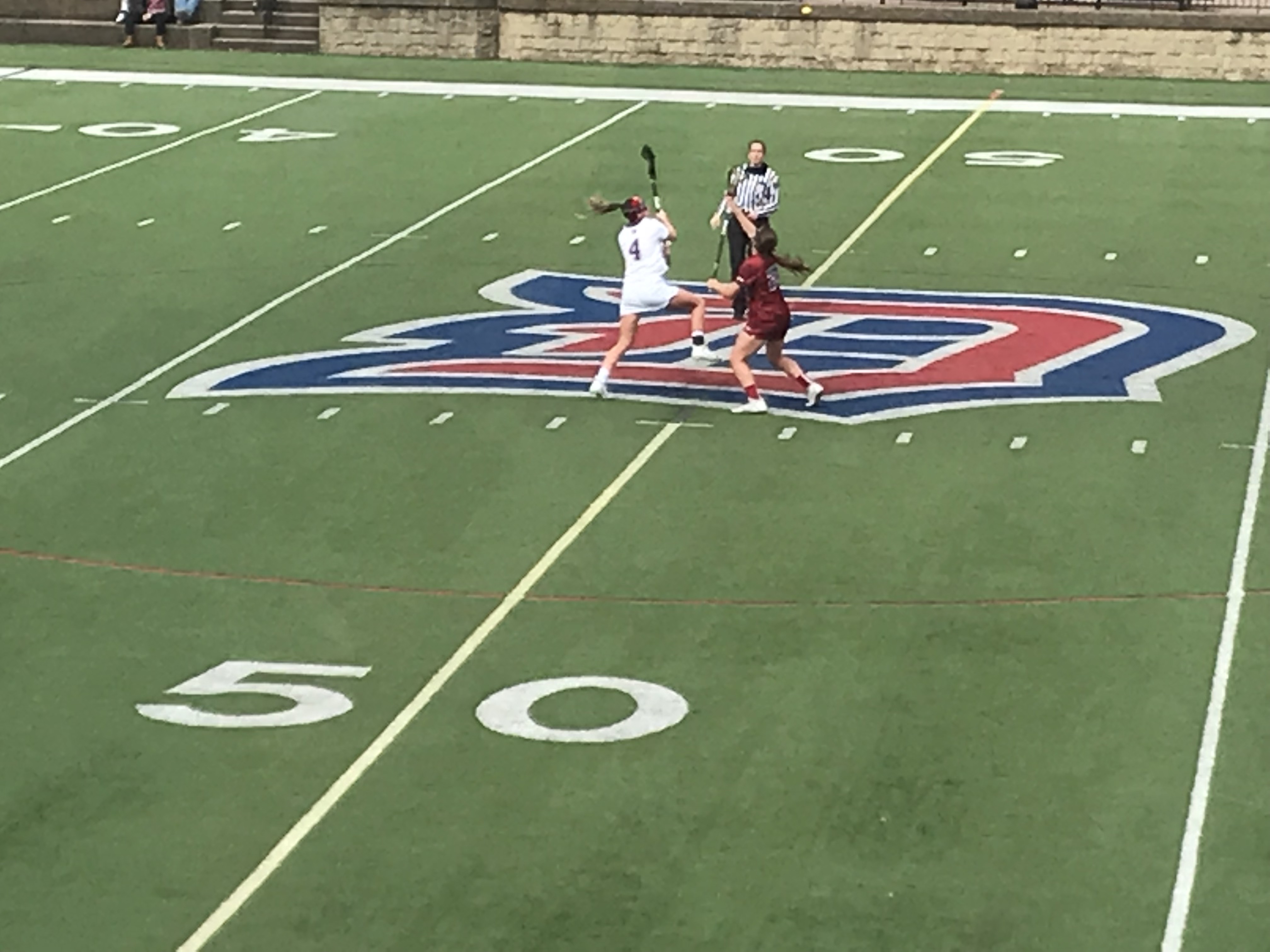
Duquesne and St. Joseph’s meet in the middle of the field for a draw.

Winning draw controls played a huge part in the Hawks win. They won a total of 21 draw controls, while Duquesne only won seven. In the second half, there were ten draw controls and St. Joe’s won 9-out of-10 of those. After the game, Hawks Head Coach, Alex Kahoe, said, “Draw controls in lacrosse are huge and its a possession to have the ball offensively and I think our team really stepped up together, had each others backs to come up with 21 draw controls today, which is great.”

The high pressure man-to-man defense style the Hawks played made it very difficult for Duquesne to score. Many of passes between the Dukes offense were unable to be completed to one another because of the Hawks high pressure. This man-man defense made it nearly impossible for the Dukes to get pass midfield with the ball. St. Joe’s defense only allowed Duquesne to take 21 shots for the whole game. On the other hand, Duquesne’s style of defense was backer-zone, but the Hawks could not be stopped and took 40 shots in total. There were many crisp and perfect passes that ended up in the back of the net. The precision of each pass and alertness each player equaled making goals look easy and flawless.

For the Dukes, Maddie Hart scored four of their six goals and Michaela Connolly had the only 2 assists of the game. 3-of-6 goals scored for Duquesne were scored off free position shots. In the second half, Duquesne did not score a goal until there was 8:06 remaining and then again with only a few seconds remaining until the end of the game.

Next up for the Duquesne Women’s Lacrosse team is an away and another A-10 match-up against University of Richmond on Friday. For the Hawks, their next game is a home game on Friday against Virginia Commonwealth University.